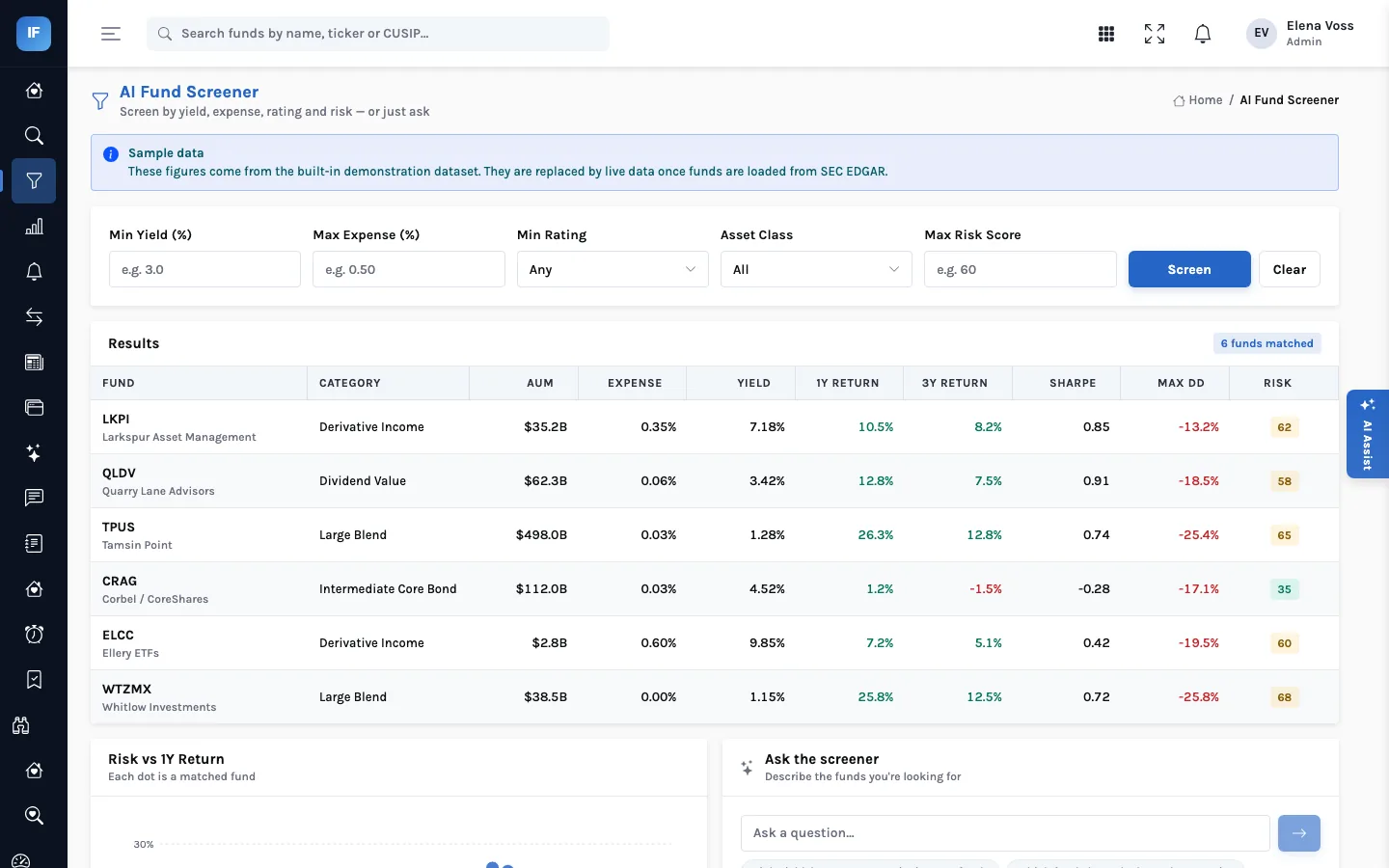
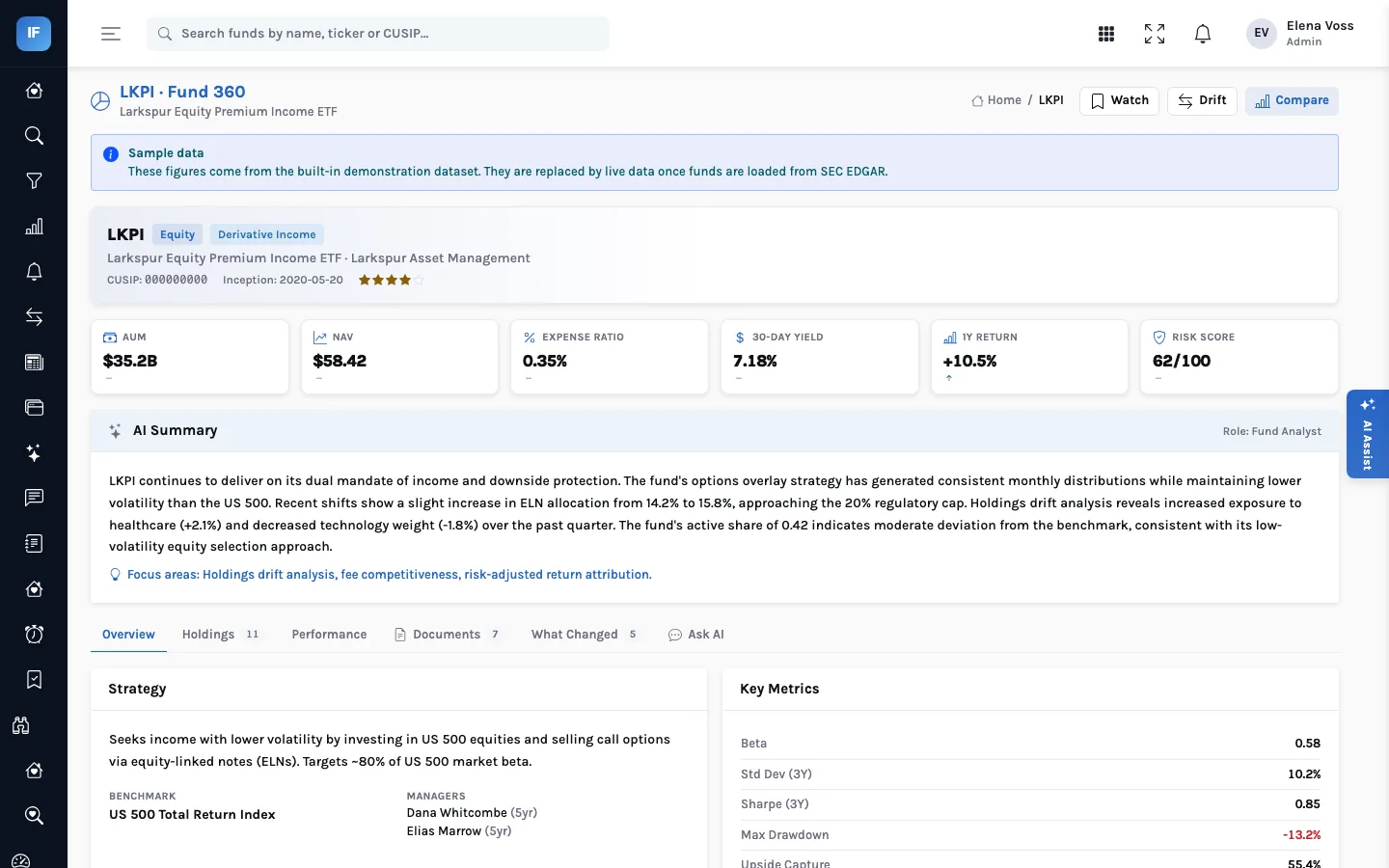
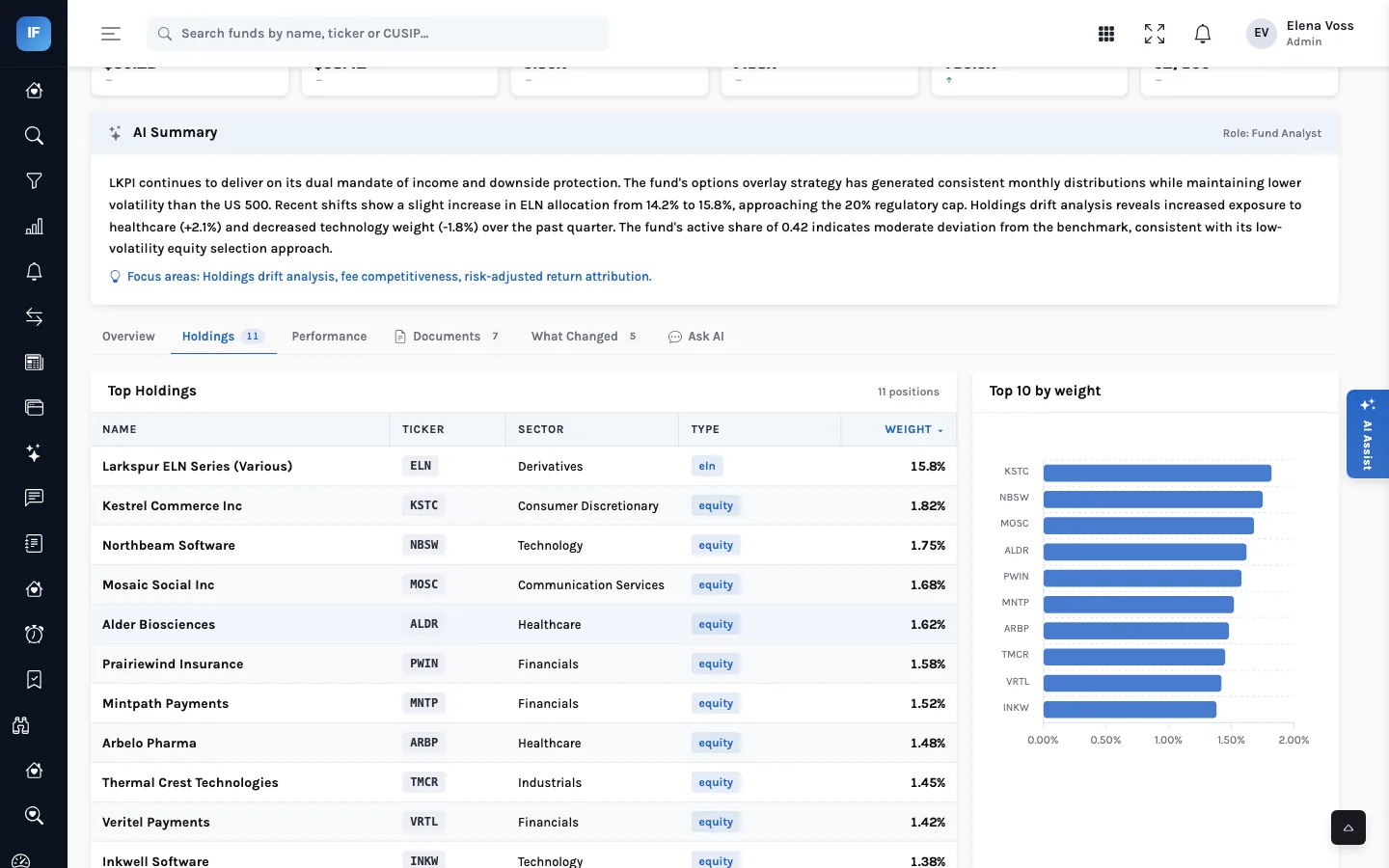
For a risk or compliance team, the interesting question about a fund is rarely its return. It is whether the fund still does what its documents say: how concentrated it has become, whether its sector exposure has wandered from the stated strategy, and whether anyone noticed in time. InsightFundz keeps the evidence for those questions together: holdings from N-PORT, the prospectus and its analysis, drift between filings, and the alerts that point at all three.
The signal
The risk team at Ashgrove Capital, a fictional wealth manager, receives an alert on QLDV, a made-up dividend equity ETF on its approved list: the top ten holdings are now 42.5% of the fund, the highest in three years, driven by three made-up companies (Brightwave, Arbelo and Hearthline). Concentration alone is not a breach. Whether it matters depends on what the fund said it would do.
Three questions, three sources
| Question | Source in InsightFundz | What to look for |
|---|---|---|
| What does it own now? | Holdings tab and sector allocation, from the latest N-PORT | The top ten, the largest sector, any single name above your own limit |
| What did it promise? | Documents tab: the prospectus, its analysis and key changes | Index methodology, diversification language, any limit that changed |
| How fast is it moving? | Holdings drift between filings; the what-changed timeline | Turnover, positions added or removed, sector weights shifting |
For an index fund the answer is often in the index rules: a dividend index that weights by yield can become concentrated when a few companies' yields rise together. For an active fund the same concentration could be a change of style, which is where the drift view and the document analysis matter.
Leaving a record
The outcome of a review should be findable later: what was checked, against which filing, on what date, and what was decided. Every fact in the review above has a source in the product (the N-PORT filing date for the holdings, the prospectus version for the strategy, the alert for the trigger), and the platform keeps an audit trail of who used it.
Within mandate, on watch
The fictional risk analyst finds that QLDV tracks a dividend index whose rules allow this level of concentration, and that its prospectus has not changed. She records the fund as within mandate, notes the three names and their weights with the filing date, and moves the fund to a watch list with high-severity alerts for holdings drift. If the next N-PORT shows the top ten rising further, the review starts from this record rather than from scratch.
Working out the concentration yourself
The top-ten figure is simple to reproduce from the Holdings tab, and reproducing it is a good habit before it goes into a record:
- Sort the latest snapshot by weight and add the ten largest weights. That sum is the top-ten concentration.
- Group the same snapshot by sector and add the weights in each. The fund's sector allocation is built the same way, from the extracted holdings' sectors.
- Repeat for the earlier snapshot and write both figures down with their report dates.
- Compare each figure with your firm's own limit for an approved-list fund of this type.
Remember what the snapshot contains. Extraction keeps the top fifty positions by weight, so top-ten and largest-sector figures are reliable, but a figure that depends on the long tail (the number of positions, or the weight of everything outside the top fifty) is not. Holdings without a sector are left out of the sector allocation.
A compliance view of the same fund
Choosing compliance officer in the “view as” selector changes the AI summary's emphasis and the copilot's instructions towards prospectus adherence, derivatives exposure limits, disclosure and distribution sustainability. The figures underneath do not change, which is what you want when two teams review the same fund.
The same switch works in the other direction: a risk analyst can view the fund as an advisor would, to see what a client-facing colleague is being told about it, before deciding whether the review needs to reach them.
A review checklist
- Trigger: which alert or routine started the review, and on what date.
- Evidence: holdings report date, prospectus version, and any supplement since.
- Test: the firm limit applied, and the measured figure against it.
- Explanation: index rules or a change of style, with the passage that supports it.
- Outcome: within mandate, on watch, or escalated, with the next review date.
Trade-offs in how you set it up
A tight watch (high-severity alerts, quarterly reviews of every approved fund) catches more but costs reviewer time on funds that are behaving as designed. A loose watch relies on alerts, each raised by the step described in the alerts article. Most teams start with a routine review of the funds closest to their limits and use the alerts as a supplement, not the trigger.
Questions
Does the audit trail record what a reviewer concluded?
The platform's audit trail records who did what in the product. The conclusion itself belongs in your review record or a team notebook; InsightFundz does not store a compliance decision as a structured field.
Is a concentration alert a breach?
No. It says a figure moved. Whether it breaches anything depends on the fund's documents and your firm's rules, which vary by firm type and jurisdiction; check the requirements that apply to you.
Next: a practical guide to loading your fund universe from EDGAR.